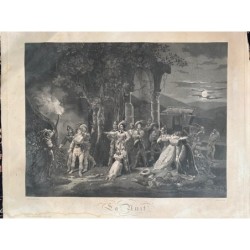
Procession of disciplinarians
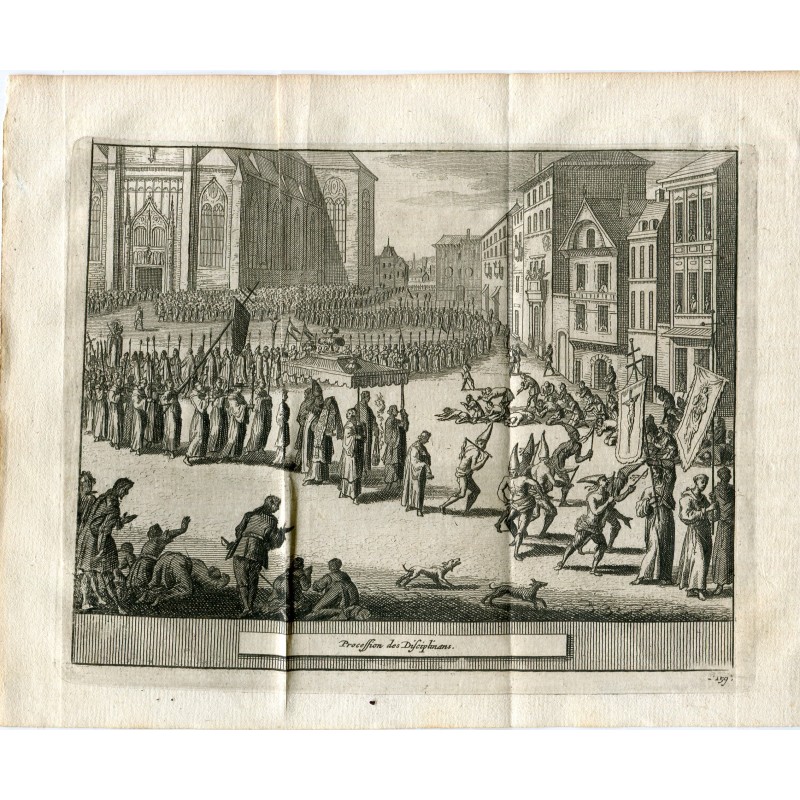
Title: Procession des Disciplinans.
Published by: Pieter van der Aa (Leiden, 1659 – Leiden, 1733) in 1715 for 'Delices de Espagne et Portugal', published in Leiden (Netherlands).
Description: Disciplinarian is the person who self-flagellates publicly as penitence within the Christian religion. It is a tradition in determined points of Spain from the xv symbol, and is carried out in processes by a group of people, of voluntary nature as the act of the Christian. It was seriously inspired by the love of Jesus Christ..
Provenance: Delices de Espagne et Portugal, published in Leiden (Netherlands) 1715.
Image size: 12,6x16 cms.
Sheet size: 16x18,1 cms
The 15th century was characterized by popular mysticism that wanted to imitate Christ, popularizing the cult of The Seven Words and elements related to the cross, such as nails and the crown of thorns. This growing fervor for passion led to the founding of the first brotherhoods of disciplinarians in Spain, usually under the name of the Brotherhood of the Blood of Jesus Christ or the Brotherhood of the True Cross, with public flagellation as their mission. The formal constitution of these brotherhoods began to occur in the 16th century.
Pieter van der Aa was a Dutch bookseller, publisher and geographer. Editor of the work entitled Les délices de l'Espagne et du Portugal, on Spanish and Portuguese life and customs, as well as descriptions of monuments and artistic works, published in Dutch "Beschryving van Spanjen en Portugal", and in the city of Leiden in 1707. That same year the French edition of that work appeared, which would be published again, also in French, in 1715 and in 1741; but in all the French versions, Juan Álvarez de Colmenar appears as the author, perhaps the pseudonym of the true author, perhaps of French origin. This work is illustrated with "figures in carved carving drawn in the same places by Juan Álvarez de Colmenar".