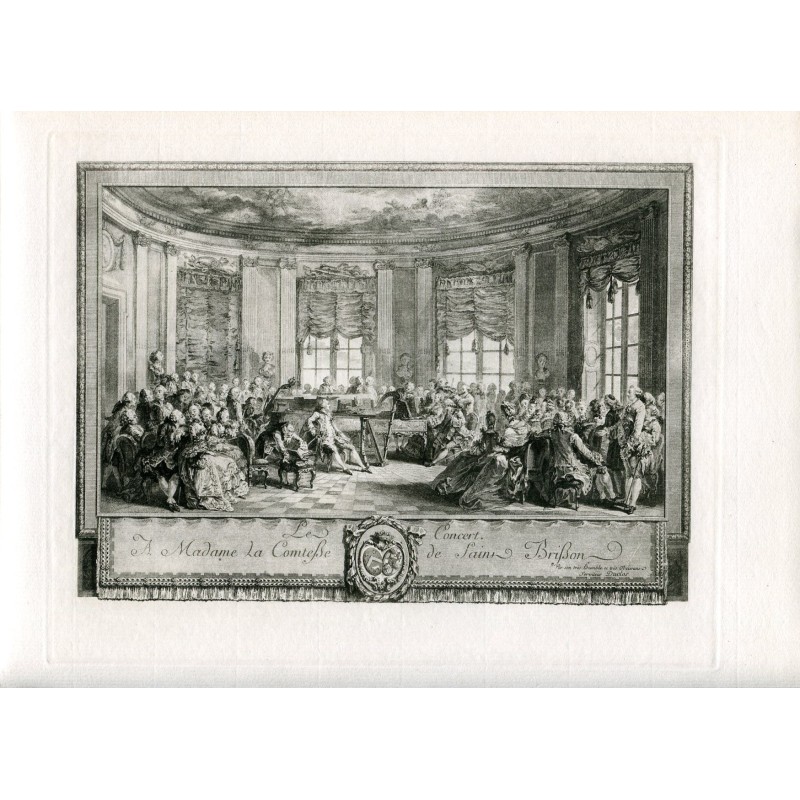
Title: Le Concert a madame la Comtesse de Saint Brisson.
Media / Technique: heliogravure etching by which an image was transferred through a photomechanical means onto a specially prepared copper plate, etched in acid, and then printed on damp paper on a hand press in limited quantities just as an etching would be.
Provenance: "French line engravings of the late XVIII century by H.W. Lawrence & B.L. Dighton." published in 1910.
Size: 25,3x32 cms (original engraving: 34,5 x 47,3 mm + margins).
Condition: Good.
Background:
Duclos's engraving, Le Concert, made after a drawing by Augustin de St Aubin in 1773, is full of musical detail, even to the decoration on the walls. Numerous instruments are to be discoveredd about the room, some of them in use, others lying about presumably awaiting another group of performers to take over. A high-ranking personage (the king [Louis XV]?) can be seen in the center, attentively listening to the music, while the other guests are enjoying the concert with him, or are busily engaged in conversation. Can it be a trio sonata they are hearing, played by flute, violin, and harpsichord with the violoncello duplicating the bass line in traditoinal fashion - or possibly a solo cantata with the same instruments, the soprano soloist standing to the right of the violinist? Both are typical "intimate" musical forms of the day which were especially cultivated in such aristocratic surroundings. The gentleman standing close to the keyboard is the inevitable page turner, and there appear to be two conscientious score readers, one in the foreground and the other before the window directly behind. A close look at the idle instruments will reveal, besides the harp, a violin and oboe on the long music stand behind the honored guest, and a violoncello and a bassoon placed against the chair on which he is leaning. A bass viol (double bass) with long neck and beautifully carved scroll is clearly visible to the left of the music stand, the bow tucked in under its strings.
This engraving, dedicated to the Countess of Brisson, is interesting not only as a costume piece and vivid picture of elegant society under Louis XV, but also as an important record of the musical life of the day." Beck & Roth