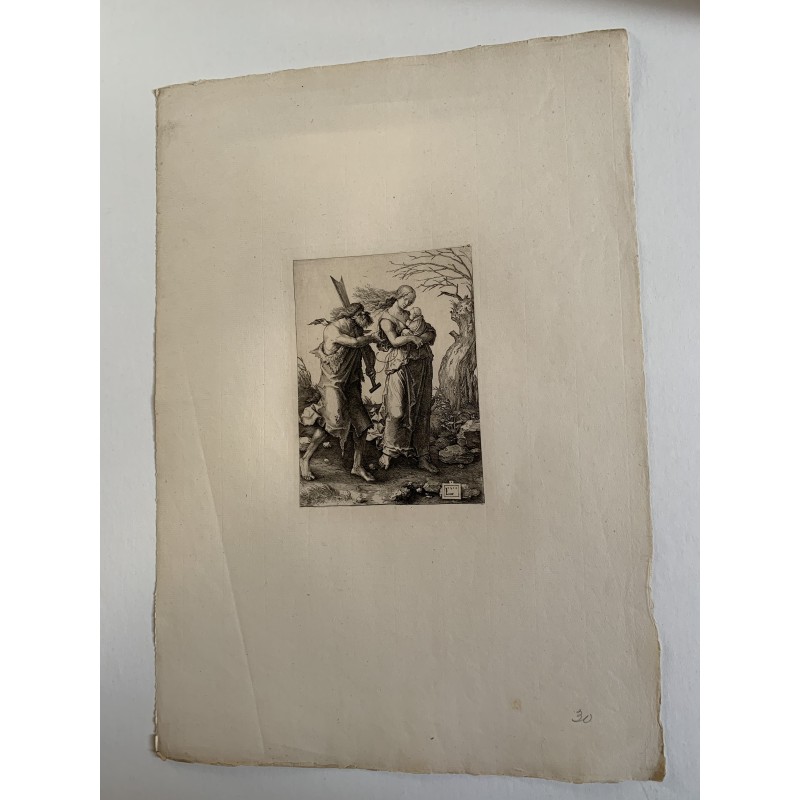
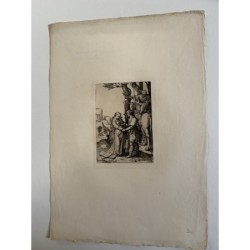
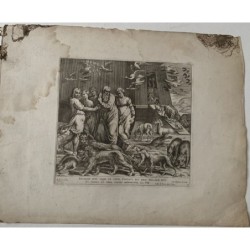
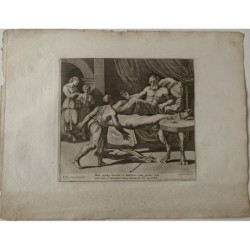
Title: Adam and Eve after the Expulsion
Artist: after Lucas van Leyden (Netherlandish, Leiden ca. 1494–1533 Leiden).
Etcher: Charles Amand-Durand, French (1831 - 1905).
Medium: heliogravure on laid paper. Signed on plate.
Image size: 12x16,2cm.
Sheet size: 31,5x46cm.
Production date: 1883
Condition: good.
Originally etched by Lucas van Leyden around 1510, heliogravure etching by Amand Durand in 1883. Amand-Durand was a master of the heliogravure etching by which an image was transferred through a photomechanical means onto a specially prepared copper plate, etched in acid, and then printed on damp paper on a hand press in limited quantities just as an etching would be.
It is a process that allowed for very detailed reproductions with all the gradations of tones found in the originals. He worked from actual fine quality prints of the original etchings, and his 19th century prints are often indistinguishable from the original artist etchings.
Lucas van Leyden is considered one of the finest engravers in the history of art. A child prodigy, he produced the "The Return of the Prodigal Son" when he was just 17 years old. Even in 1883 when this reproduction was made the engraving was considered quite rare.
In his comments on the work in The Portfolio, Sidney Colvin wrote: "M. Amand Durand's reproduction leaves, as usual, remarkably little to be desired, and possesses all but the crispness and delicacy of a good early impression of the original." This is a very fine heliogravure of a rare, important work that has been expertly duplicated by Amand-Durand.
Lucas van Leyden was the first great Renaissance master printmaker produced by the Netherlands. Something of a child prodigy, he was first influenced by Albrecht Durer's works toward the end of the first decade of the sixteenth century. In 1521, Lucas and Durer met during Durer's trip to the Netherlands to try to win the support of the new Regent of the Netherlands for the renewal of the pension granted him by the Emperor Maximilian I. We know from Durer's diary of the trip that they met and enjoyed each other's art and company.
After Durer left, van Leyden was again challenged by the quality of Durer's works to rethink his engraving. Van Leyden combined the native Netherlands tradition with Durer's inspiration and the Italian style that Jan Gossaert had brought back with him when he returned from Italy after the death of Pope Adrian VI, and gave birth to a style that dominated Dutch printmaking for almost 100 years.