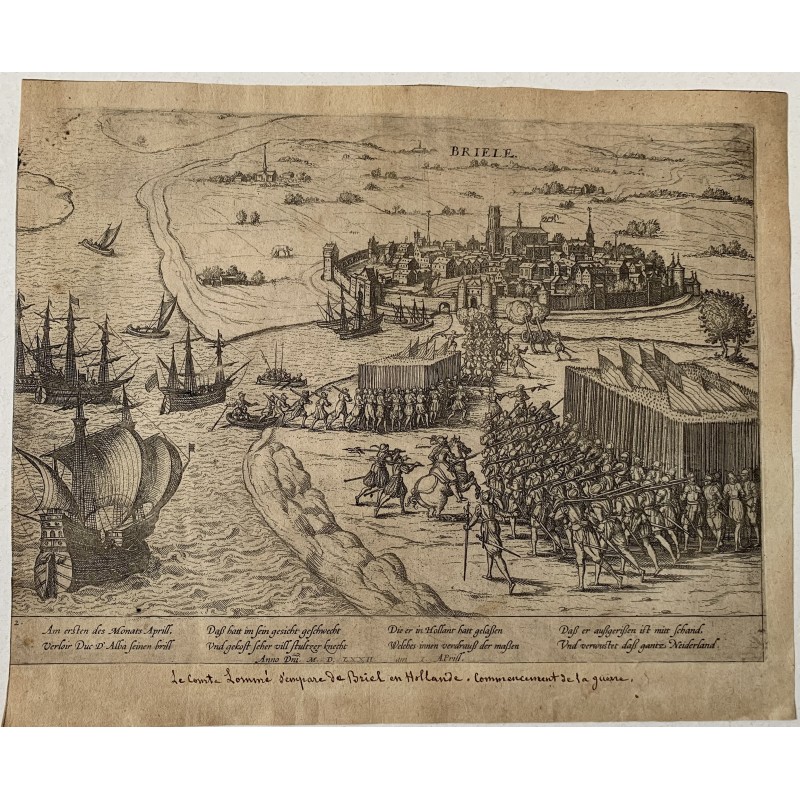
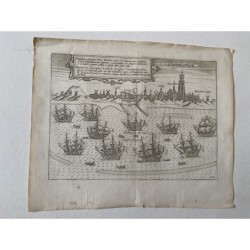
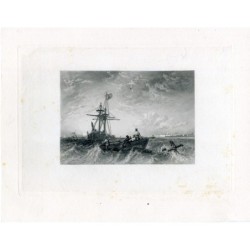
Capture of Brielle, 1 April 1572.
Etcher: anonymus
After: Frans Hogenberg (Mechelen, 1535 – Keulen, 1590).
Media / technique: etching.
Production date: 1613 - 1615.
Size: 29,8x24,5 cms.
Condition: trimmed to image on left margin.
Background:
Brielle is a fortress town. Its rich history is still clearly visible in this stronghold. Brielle has a place in the history books, because it was liberated from the Spaniards by the 'Watergeuzen' (Sea Beggars) on 1 April 1572.
The Sea Beggars were men from all parts of the Dutch population who had been forced to flee from the Spanish rule. They roamed the seas. In 1572, the English Queen Elizabeth I forbade the Sea Beggars to stay in English harbours any longer. They set sail for North Germany but had to change course because of a storm.
On the 1st of April 1572, Willem Bloys of Treslong and the Sea Beggars fleet sailed into the Mouth of the Meuse and dropped anchor in front of Brielle. Admiral Lumey and Bloys van Treslong demanded that the town council surrender the town. When there was no response from the town council, the Sea Beggars rammed the Noordpoort (north gate) with a ship's mast. The town council surrendered and Brielle was liberated from the Spanish. From then on, it could call itself Libertatis primitiae (the first to be liberated).
The Spanish commander-in-chief, Alba, lost 'his Brielle'. It was an important moment in the course of the Eighty Years' War and it meant that Brielle was the first free town in the Netherlands. The local population celebrates that historic fact every year on 1 April.