Europe
Antique prints of Europe
This is the largest section of the shop: nearly 1,500 antique prints of Europe, from the sixteenth century to the twentieth. Steel and copper engravings, lithographs, wood engravings and original drawings show cathedrals, castles, ports and landscapes from the British Isles to the Rhine, the Alps and the Mediterranean.
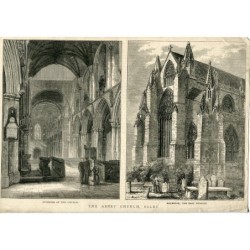
British engravers such as Edward Francis Finden, J. Storer and J. Greig are well represented, along with French steel engravings by Rouargue. Typical pieces include the churches of Oxford, Katz castle on the Rhine, the cloister of Chester cathedral and the Drachenfels.
Browse by country to narrow the selection. All prints are period originals unless stated otherwise, with a technical description and measurements for every piece.

Subcategories
-

Germany
Antique prints of Germany
These antique prints of Germany date from 1833 to 1878 and are dominated by the Rhine: Kaub, the Pfalz and Gutenfels castle in steel engravings and in a wood engraving by R. Püttner of 1878. Aachen, Hanover, the town hall of Halberstadt by Carl Werner and the spa of Bad Ems, in a lithograph printed at Darmstadt, extend the selection across the country.
The engravers Albert Henry Payne, J. Outhwaite, John Godfrey and Ferdinand Jean Joubert worked for the illustrated travel publications of the period, which spread the Romantic image of the Rhine throughout Europe.
All pieces are period originals unless stated otherwise, with a technical description and measurements.
-

Austria
Antique prints of Austria
Our antique prints of Austria date from 1840 to 1873. Steel engravings after W. H. Bartlett, by W. Mossman and Robert William Wallis, show the Danube at the Wirbel and Haustein rapids and the Nuns' Tower; A. H. Payne engraved Naudersberg castle in Tyrol, and there are views of the Carinthian gate of Vienna and the Spinnerin am Kreuz on the road to Baden.
A wood engraving of the Vienna World Exhibition of 1873 closes the group. Danube scenery from Bartlett's travels was among the most popular Austrian imagery in nineteenth-century England.
All pieces are period originals unless stated otherwise, with a technical description and measurements.
-

Belgium
Antique prints of Belgium
Our antique prints of Belgium, dated 1834 to 1920, include steel engravings of Mechelen cathedral by John J. Crew, Ghent town hall after Thomas Allom (1851), the field of Waterloo by R. Brandard and a hand-coloured view of the palace courtyard at Liège by L. J. Wood. Thomas Heawood, John Henry Le Keux and William Henshall also appear. Bruges is represented by original etchings of the town hall and the Blind Donkey street.
The Flemish cities, with their belfries and Gothic halls, were a regular stop on nineteenth-century tours and a favourite of British engravers.
All pieces are period originals unless stated otherwise, with a technical description and measurements.
-

Bulgaria
Antique prints of Bulgaria
Our antique prints of Bulgaria date from around 1840, when the country was still an Ottoman province. Steel engravings after W. H. Bartlett, by J. Godfrey and R. Wallis, show the Balkan range from Vidin and the Danube fortress of Nicopolis; a plate by Traversier under Lemaître's direction shows Burgas on the Black Sea, and a wood engraving by H. Catenacci depicts Tarnovo, the old capital.
These are among the few printed views of Bulgarian towns before independence and interest collectors of Danube and Balkan topography.
All pieces are period originals unless stated otherwise, with a technical description and measurements.
-

Czechia and Slovakia
Antique prints of Czechia and Slovakia
Our antique prints of Czechia and Slovakia date from 1842 to 1845. Prague and the Charles Bridge appear in a hand-coloured steel engraving by Albert Henry Payne; the castle of Devín (Theben) above the Danube near Bratislava is engraved after W. H. Bartlett by J. C. Armytage; and a wood engraving by J. Fagnion shows Orava castle above the river Váh.
Bartlett's Danube views and Payne's series published in Germany were the main sources of images of Bohemia and Upper Hungary for nineteenth-century readers.
All pieces are period originals unless stated otherwise, with a technical description and measurements.
-

Denmark
Antique prints of Denmark
Our antique prints of Denmark comprise three pieces from 1845 to 1859: Frederiksborg castle engraved by Auguste Lemaître in 1845, a hand-coloured view of the Copenhagen observatory of 1848, and a German wood engraving of 1859 showing Jutland peasants in costume.
Frederiksborg, the Renaissance palace of Christian IV, was engraved shortly before the fire of 1859 that gutted it, so early views like this one have documentary interest. The costume print belongs to the ethnographic illustration popular in the German press of the period.
All pieces are period originals unless stated otherwise, with a technical description and measurements.
-

France
Antique prints of France
Our antique prints of France span more than three centuries, from 1612 to 1940. The earliest are seventeenth-century copper engravings by Pierre Aveline of Versailles and the château of Saint-Germain-en-Laye; the nineteenth century brings steel engravings by Rouargue and the workshop of Auguste Lemaître, including the port of Bordeaux and the Val d'Azun in the Pyrenees.
Original drawings complete the section, such as a pen study of Chambéry in Savoy and a pencil sketch of Saint-Léonard near Boulogne. Paris has its own sub-category.
All pieces are period originals unless stated otherwise, with a technical description and measurements.
-

United Kingdom
Antique prints of the United Kingdom
With close to a thousand pieces, our antique prints of the United Kingdom cover England, Scotland, Wales and London in depth, from the mid-seventeenth century to the twentieth. Most are copper and steel engravings from the topographical series of the Georgian and Victorian eras, with lithographs and original watercolours alongside.
Engravers such as J. Storer, J. Greig and Edward Francis Finden recorded Dover Castle, Truro church, Newstead Abbey and countless parish churches, country houses and docks. An 1865 watercolour of Ullswater shows the Lake District as painted on the spot.
Browse by nation or city in the sub-categories. All pieces are period originals unless stated otherwise, with technical description and measurements.
-

Greece
Antique prints of Greece
Our antique prints of Greece combine nineteenth-century steel engravings with original drawings. James Heath engraved the ruins of Athens; Robert William Wallis, after Bartlett, the site of Nicopolis; other plates show the temple of Apollo at Bassae in Arcadia and Greek remains at Candia in Crete. Two pen-and-ink drawings signed R. Fernández depict the Acropolis and the Parthenon.
Classical Greece was the destination of the educated traveller, and these views were made for the archaeological and travel books that followed independence.
All pieces are period originals unless stated otherwise, with a technical description and measurements.
-

Netherlands
Antique prints of the Netherlands
Our antique prints of the Netherlands date from 1613 to 1899. A hand-coloured copper engraving of the Utrecht gate of Amsterdam from 1693 is the earliest view; the nineteenth century brings steel engravings of The Hague by William Finden (1833), Rotterdam cathedral after Bartlett and Amsterdam by Aubert, along with plates by Francis Garden, Léonce Lhuilier and W. Floyd.
Naval history is present too, with an 1844 lithograph of the battle of Kijkduin of 1673 between Tromp and Spragge, one of the last actions of the Anglo-Dutch wars.
All pieces are period originals unless stated otherwise, with a technical description and measurements.
-

Hungary
Antique prints of Hungary
Our antique prints of Hungary include two copper engravings by Gaspar Bouttats from 1683, made in Antwerp at the time of the wars against the Ottomans: the town of Eger (Erlau) and the fortress of Nógrád. A nineteenth-century wood engraving of Visegrád, the medieval residence of the Hungarian kings on the Danube, completes the group.
Bouttats' small views were issued to illustrate the campaigns that followed the siege of Vienna and are among the earliest printed images of these towns.
All pieces are period originals unless stated otherwise, with a technical description and measurements.
-

Ireland
Antique prints of Ireland
Our antique prints of Ireland date from 1816 to 1881. Steel engravings after William Henry Bartlett, by Robert Wallis and Robert Hinshelwood, show the Salmon Leap at Leixlip and the lakes of Killarney; there are also a view of the Giant's Causeway by Schroeder, a coloured print of the western cliffs after Harry Fenn and an etching of the Vale of Avoca by Francis Walker.
The earliest piece is a view of Dublin published by Thomas Kelly in 1816. Irish scenery reached a wide public through the illustrated travel books of the 1840s.
All pieces are period originals unless stated otherwise, with a technical description and measurements.
-

Italy
Antique prints of Italy
Our antique prints of Italy run from 1570 to 1955, with Rome at their centre: the steps of the Capitol, the catacombs engraved by J. Heath around 1817, and views by the Roman engraver Domenico Amici. Naples and Vesuvius, Genzano in the Alban hills, Trento and the castle of Brunnenburg near Merano are also represented.
Most pieces are nineteenth-century steel engravings by J. C. Varrall, John Smith and Rouargue, some coloured by hand after J. D. Harding. They record the Italy of the Grand Tour and of the first railway travellers.
All pieces are period originals unless stated otherwise, with a technical description and measurements.
-

Portugal
Antique prints of Portugal
Our antique prints of Portugal date from 1707 to 1846. A notable group comes from Pieter van der Aa's Leiden edition of 1715: the royal palace and its square in Lisbon, the port and church of Belém, and the fortified town of Arronches. English steel engravings follow, with the Capuchin convent at Sintra by Edward Francis Finden (1832) and the castle of Punhete on the Tagus by James Heath (1817).
These views show Lisbon before the earthquake of 1755 and the Portugal that Byron travelled through, of interest to collectors of Iberian topography.
All pieces are period originals unless stated otherwise, with a technical description and measurements.
-

Romania
Antique prints of Romania
Our antique prints of Romania are steel engravings of 1840 to 1842 after William Henry Bartlett, by E. Benjamin, William Mossman, Edward Paxman Brandard and Robert Wallis, several coloured by hand: the baths of Mehadia, the Kazan gorge and the remains of Trajan's bridge on the Danube, and Drey Kule near Svinița. A plate by F. Krostewitz shows the road through Wallachia.
Bartlett's journey down the Danube produced the best-known Romantic views of the Iron Gates, and these prints are the usual source for early images of the region.
All pieces are period originals unless stated otherwise, with a technical description and measurements.
-

Russia
Antique prints of Russia
Our antique prints of Russia are wood engravings from the French illustrated press of 1877 to 1881: Arkhangelsk by J. Gauchard, a general view of the Kremlin in Moscow by Charles Laplante and Clerget, a distribution of soup to the poor in St Petersburg and the expulsion of the Jews from Kiev in 1881.
These plates were cut for the illustrated magazines of the time and are among the few affordable period images of nineteenth-century Russia, of interest for both topography and social history.
All pieces are period originals unless stated otherwise, with a technical description and measurements.
-

Sweden
Antique prints of Sweden
Our antique prints of Sweden are three small engravings of 1839 to 1840: the royal palace of Stockholm as it stood in the seventeenth century, engraved by Lemaître; the Kullen lighthouse on the Öresund; and a view of Uppsala. They were made for illustrated works on the countries of Europe and are typical of the period.
The old Tre Kronor castle of Stockholm, destroyed by fire in 1697, survives mainly through prints of this kind, which makes even modest plates useful to collectors of Scandinavian topography.
All pieces are period originals unless stated otherwise, with a technical description and measurements.
-

Switzerland
Antique prints of Switzerland
Our antique prints of Switzerland date from 1832 to 1910 and centre on the Alpine views engraved for English annuals and travel books: the Simplon pass, the dungeon of Chillon castle, Thun and Lake Lungern. Edward Francis Finden, John Saddler after Birket Foster, Charles W. Sharpe, A. H. Payne and Rouargue are the main engravers, and several prints are coloured by hand.
A steel engraving of the Arnold von Winkelried fountain recalls the national legend. Together these pieces show the Switzerland that Romantic travellers came to see.
All pieces are period originals unless stated otherwise, with a technical description and measurements.
-

Turkey
Antique prints of Turkey
Our antique prints of Turkey date from 1783 to 1853. The earliest are copper engravings by William Angus of the Seraglio at Constantinople and the Dardanelles; the nineteenth century brings steel engravings after Thomas Allom by A. Willmore and Ebenezer Challis, and French plates from the Lemaître workshop, including the tomb of Raghib Pasha and Leander's Tower on the Bosphorus.
Istanbul and the ancient sites of Asia Minor, such as Thyatira, were a fixed stop for the Orientalist illustrators of the period, and their views remain the classic image of the Ottoman capital.
All pieces are period originals unless stated otherwise, with a technical description and measurements.
-

Malta
Antique prints of Malta
Our antique prints of Malta are steel engravings of around 1840 from the Lemaître workshop in Paris and by Aubert: the island of Gozo, Fungus Rock, the Bengemma hills, the so-called temple of Hercules at Marsaxlokk and the remains of a house of Greek construction. Small in size and finely engraved, they were published in a French series on the islands of the Mediterranean.
Malta under British rule attracted antiquarian interest for its megalithic and classical remains, which these plates record before later excavation.
All pieces are period originals unless stated otherwise, with a technical description and measurements.
-

Poland
Antique prints of Poland
Our antique prints of Poland come chiefly from French steel-engraved series of around 1840 produced under the direction of Lemaître, with plates by Cholet, Lepetit, Desaulx and after J. Arnout. Subjects include the Sigismund column in Warsaw by Ch. Lalaisse, Łazienki palace, St Florian's gate and the Kościuszko mound in Kraków, the castle of Ostróg and the tomb of Mieszko I and Bolesław the Brave in Poznań.
These small, finely cut views were made for encyclopaedic works on the nations of Europe and are the usual way to collect early images of Polish cities.
All pieces are period originals unless stated otherwise, with a technical description and measurements.