Spain
Antique prints and views of Spain
Over four hundred antique prints of Spain, from the small copper engravings published by Pieter van der Aa in Leiden in 1707 and 1715 to the plates of Laborde's Voyage pittoresque, the Romantic lithographs of Parcerisa, nineteenth-century steel engravings and twentieth-century etchings and drawings by Eduardo Rodríguez Samper.
Spain was a great subject of the European travel print. Foreign engravers recorded Madrid, Seville, Granada and Toledo, pilgrims to Compostela, markets, ports and costume long before photography, so these plates record how towns once looked.
Browse by province to find views of your own city. Every piece is an original of its period unless stated otherwise, with technical details and measurements.

Subcategories
-

A Coruña
Antique prints of A Coruña and Santiago de Compostela
Three antique prints of A Coruña province, all copper engravings published by Pieter van der Aa in Leiden in 1707 and 1715. They show the procession of pilgrims arriving at Santiago de Compostela, one of the few early printed images of the pilgrimage and its rituals.
Galicia was poorly served by engravers until the nineteenth century, so these small plates have real documentary value for anyone interested in the Camino de Santiago. All pieces are original unless stated otherwise, with technical details and measurements in each listing.
-

Barcelona
Antique prints of Barcelona and Montserrat
Twenty antique prints of Barcelona and its province, 1707 to 1967. The earliest is a panoramic view of the city engraved for Pieter van der Aa, followed by plates from Laborde's Voyage pittoresque (1806–1810) engraved by Dequevauviller, Garreau and Fortier: the hermitage of Sant Miquel de Mata near Mataró and the waterfalls of Sant Miquel del Fai, some in period colour. Montserrat recurs in a Van der Aa engraving, an 1844 lithograph by F. Pérez and a 1967 signed watercolour of a Catalan farmhouse below the mountain.
These views show Barcelona before the Eixample and the sacred mountain as pilgrims saw it.
All pieces are original unless stated otherwise, with technical details and measurements.
-

Tarragona
Antique prints of Tarragona
Thirteen antique prints of Tarragona and its province, nearly all from Alexandre de Laborde's Voyage pittoresque et historique de l'Espagne, engraved in Paris between 1806 and 1810 by Lorieux, Baltard, Perdoux, Réville and Michel. The Roman heritage of the city is the main theme: the Torre del Pretorio, the Tomb of the Scipios and the Tower of the Scipios on the Via Augusta. The series continues with the Monastery of Poblet and the castle of Amposta, several in period hand-colouring.
Laborde's plates are among the finest views of Catalonia ever engraved, drawn on the spot before the Peninsular War.
All pieces are original unless stated otherwise, with technical details and measurements.
-

Alicante
Antique prints and postcards of Alicante
Close to thirty antique prints of Alicante and its province, dated between 1810 and 1998. The oldest is an engraving from Laborde's Voyage pittoresque showing Cape San Antonio and the tomb at Daimús. The twentieth century brings original drawings and watercolours by Alicante artists: Eduardo Rodríguez Samper, with subjects such as the palm grove of Elche, and Gastón Castelló, with a signed allegory of the port. Early postcards of the Explanada, the Plaza de Ramiro and views photographed by Roisin complete the group.
Orbis is based in Alicante, so this category grows steadily with local subjects that are hard to source elsewhere.
All pieces are original unless stated otherwise, with technical details and measurements.
-
Álava (old)
Alte Stiche von Álava
Die Provinz Álava ist in dieser Kategorie mit ihrer Hauptstadt Vitoria-Gasteiz vertreten. Die alten Ansichten von Álava zeigen den Markt von Vitoria mit der Kirche San Pedro in Stahlstichen des 19. Jahrhunderts, eines davon in altem Kolorit – eine belebte Szene aus der Zeit, als Vitoria als Etappe zwischen Kastilien und der französischen Grenze von vielen Reisenden beschrieben wurde.
Für Sammler baskischer Themen, für Freunde der Stadt und als Geschenk mit lokalem Bezug. Weitere Blätter aus der Provinz nehmen wir laufend auf.
Alle Blätter sind Originale ihrer Zeit, sofern nicht anders angegeben, mit Datenblatt und Maßen.
-

Badajoz
Antique prints of Badajoz and Mérida
Seven antique prints of Badajoz province, dated between 1707 and 1810. Pieter van der Aa's copper engravings show Olivenza, the border town that passed from Portugal to Spain in 1801. The rest come from Laborde's Voyage pittoresque, engraved by Lorieux, Berthault, Rousseau and Baugean: the Roman baths of Alange and their plan, and two plates devoted to Mérida, with the hermitage and statue of Saint Eulalia and the fragments of her column.
Mérida's Roman remains made Extremadura a required stop for Laborde's draughtsmen, and these are among the earliest printed views of its monuments.
All pieces are original unless stated otherwise, with technical details and measurements in each listing.
-

Biscay
Antique prints of Biscay and Bilbao
Five antique prints of Biscay. Two copper engravings published by Pieter van der Aa in 1715 show the town of Bilbao and the costumes of Biscayan men and women. From the twentieth century come signed etchings by Verdaguer of the Arch of Santa Ana in Durango and the tower of Muntsaratz in Abadiño, one of them hand-coloured, and an old photogravure reproduction of an aurresku danced at Begoña.
Old views of Bilbao before its industrial growth are scarce, and the eighteenth-century costume plates are a rare record of Basque dress.
All pieces are original unless stated otherwise, with technical details and measurements in each listing.
-

Burgos
Antique prints of Burgos
Seven antique prints of Burgos, from 1707 to 1937. A general view of the city was engraved for Pieter van der Aa in 1707. The nineteenth century contributes two interiors of the cathedral, one by Antonio Roca of 1853, and steel engravings after David Roberts of the ruined Carmelite convent, first published in 1835. The group closes with an original 1937 souvenir print with a Civil War stamp.
The Gothic cathedral of Burgos, with its openwork spires by Juan de Colonia, was the monument that drew engravers to the city on the road to Santiago.
All pieces are original unless stated otherwise, with technical details and measurements in each listing.
-

Cadiz
Antique prints of Cadiz
Nearly thirty antique prints of Cadiz and its province, from 1707 to 1899. The earliest are copper engravings by Pieter van der Aa, with views of Vejer and the Strait, and of Setenil de las Bodegas. From the eighteenth century comes a hand-coloured optical view of Cadiz from the harbour published by Chéreau in Paris. Nineteenth-century steel engravings show Jerez de la Frontera and the interior of its collegiate church, after Rouargue, and a photogravure after Clarkson Stanfield records the battle of Trafalgar.
Cadiz, Atlantic port of the Spanish monarchy, was a natural subject for engravers.
All pieces are original unless stated otherwise, with technical details and measurements.
-

Cantabria
Antique prints of Cantabria and Santander
Four antique prints of Cantabria. Two copper engravings published by Pieter van der Aa in 1707 and 1715 show Santander and its harbour as a small fortified port. The twentieth century is represented by a signed and numbered etching of the port of Santander by Verdaguer and an etching by Eugenio Lemus of the Romanesque collegiate church of Santillana del Mar.
Early views of the Cantabrian coast are rare, and the Van der Aa plates are among the first printed images of Santander. All pieces are original unless stated otherwise, with technical details and measurements in each listing.
-

Cordoba
Antique prints of Cordoba
Fourteen antique prints of Cordoba, dated between 1707 and 1840. The earliest is a general view of the city engraved for Pieter van der Aa. Most of the group is nineteenth-century: a steel engraving of the exterior of the Mezquita by Edward Goodall, a view of the mosque by Le Petit, the city seen from the Guadalquivir, a chromolithograph of the interior of the Mosque-Cathedral and a lithograph by Asselineau of the doorway of the Hospital de San Sebastián.
The Mezquita, the great mosque of the caliphate, was the monument that drew Romantic artists to Cordoba.
All pieces are original unless stated otherwise, with technical details and measurements.
-

Gipuzkoa
Antique prints of Gipuzkoa
Ten antique prints of Gipuzkoa. The core is a set of copper engravings published by Pieter van der Aa in Leiden in 1707 and 1715: views of San Sebastián with its bay and Mount Urgull, and of Fuenterrabía, the fortified town on the Bidasoa. A nineteenth-century steel engraving after Clarkson Stanfield shows Irun and the bridge over the Bidasoa, the frontier crossing into France, and an old reproduction records the sanctuary of Saint Ignatius at Loyola.
These early views show San Sebastián as a small walled port long before its Belle Époque expansion, which gives them particular local interest.
All pieces are original unless stated otherwise, with technical details and measurements in each listing.
-

Girona
Antique prints of Girona
Five antique prints of Girona and its province, dated between 1810 and 1864. Two plates come from Laborde's Voyage pittoresque, engraved by Dequevauviller: a view of the city from Pedret and an architectural plate of the Arab baths. The lithographic workshop of Pérez y Donon produced a view of Girona in 1844 and one of Hostalric in 1851, and Antonio Roca Sallent engraved a further view of the city in 1864.
Girona's walled old town and its cathedral above the river Onyar have changed little since these views were drawn, which makes them satisfying to compare with the city today.
All pieces are original unless stated otherwise, with technical details and measurements in each listing.
-

Granada
Antique prints of Granada and the Alhambra
Some fifty antique prints of Granada, dated from 1707 to 1937. Most come from the workshop of Pieter van der Aa in Leiden, whose 1715 engravings show the Alhambra with a numbered key, the Generalife, the Palace of Charles V and a general view of the city. Later plates include the Arab baths engraved for Laborde's Voyage pittoresque (1810) and nineteenth-century lithographs such as the mausoleum of the Catholic Monarchs.
Granada was the most sought-after Spanish subject among Romantic travellers, and these early views record the Nasrid palaces before the restorations of the nineteenth and twentieth centuries.
All pieces are original unless stated otherwise, with technical details and measurements in each listing.
-

Madrid
Antique prints of Madrid
Around a hundred antique prints of Madrid and its surroundings, dated between 1707 and 1870. The core is the series of copper engravings published by Pieter van der Aa in Leiden in 1715: the old Alcázar, the Puerta del Sol and its fountain, the Plaza de la Cebada. Alongside them are plates from Laborde's Voyage pittoresque (1810), steel engravings by Edward Finden and etchings by Francisco de Goya.
The category also covers the royal sites: the Monastery of El Escorial, the Chair of Philip II and the fountains of Aranjuez, favourite subjects of travelling artists.
All pieces are original unless stated otherwise, with technical details and measurements in each listing.
-

Malaga
Antique prints of Malaga
Seventeen antique prints of Malaga and its province. The core is a set of copper engravings published by Pieter van der Aa in Leiden in 1707 and 1715: a view of the city of Malaga, and views of Antequera, Vélez-Málaga and Cártama. The nineteenth century adds steel engravings with a general view of Malaga and a hand-coloured view of the city from the castle of Gibralfaro, by Lalaisse among others.
The port of Malaga, with the Alcazaba and Gibralfaro above it and the cathedral in the foreground, was a standard stop for artists on the coast of Andalusia.
All pieces are original unless stated otherwise, with technical details and measurements.
-

Salamanca
Antique prints of Salamanca
Three antique prints of Salamanca and its province. A nineteenth-century engraving after H. Fenn shows the Roman bridge with the cathedrals above it; a hand-coloured lithograph records the castle of Alba de Tormes, seat of the Dukes of Alba; and a later print bears the title Castilla Madre Salamanca.
Salamanca's golden sandstone and its university buildings have been drawn since the Romantic period, and views of the province are still scarce. All pieces are original unless stated otherwise, with technical details and measurements in each listing.
-

Segovia
Antique prints of Segovia
Thirteen antique prints of Segovia and its province, from 1707 to 1955. The Alcázar is the recurring subject, in several copper engravings published by Pieter van der Aa in 1707. The Roman aqueduct appears in a nineteenth-century lithograph by M. Pujadas, and the castle of Cuéllar in a hand-coloured lithograph by Parcerisa. An optical view of about 1760 shows the cascades in the gardens of La Granja de San Ildefonso.
Segovia's aqueduct and castle made it one of the Castilian cities most often drawn by travellers, and early views show the Alcázar before the fire of 1862.
All pieces are original unless stated otherwise, with technical details and measurements.
-

Seville
Antique prints of Seville
Forty-one antique prints of Seville and its province, dated between 1707 and 1770. Almost all are copper engravings published by Pieter van der Aa in Leiden: a general view of the city, the cathedral and Giralda, and small towns rarely found in print, such as Marchena, Los Palacios and San Juan de Aznalfarache. Nineteenth-century lithographs by Parcerisa, including the courtyard of the Alcázar, complete the group.
As the port of the Indies trade, Seville appeared in European city atlases from the sixteenth century onwards, and Van der Aa's views belong to that tradition.
All pieces are original unless stated otherwise, with technical details and measurements.
-

Toledo
Antique prints of Toledo
Seventeen antique prints of Toledo, from a Pieter van der Aa engraving of 1715 to a 1937 ink drawing for a Civil War souvenir vignette. The strongest group is nineteenth-century lithography: Asselineau's plates of the cathedral interior, the cloister of San Juan de los Reyes and the Hospital de Santa Cruz, and views of the Puerta del Sol by Parcerisa, with figures by Puiggarí, and by M. Pujadas, some in original colour.
Toledo, with its Gothic, Mudéjar and Renaissance monuments crowded on a hill above the Tagus, was a favourite of the Romantic lithographers.
All pieces are original unless stated otherwise, with technical details and measurements.
-

Valencia
Antique prints of Valencia
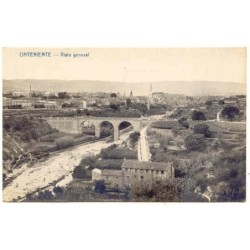
Thirteen antique prints of Valencia and its province, dated between 1810 and 1937. The earliest plates come from Laborde's Voyage pittoresque, engraved by Dequevauviller after etchings by Coulet, Garreau and Devilliers: the Serranos gate, in period colour, and the plan of the temple of the Nymphs at Llíria. A hand-coloured engraving after David Roberts (1835) shows the tower of Santa Catalina. The group closes with a souvenir engraving of the Valencia prison, an old postcard of the spa at Ontinyent and a 1937 ink drawing for a Civil War vignette.
All pieces are original unless stated otherwise, with technical details and measurements in each listing.
-

Valladolid
Antique prints of Valladolid
Five antique prints of Valladolid, dated between 1715 and 1921. Three are copper engravings published by Pieter van der Aa in Leiden in 1715, with general views of the city that was briefly capital of Spain under Philip III. From Laborde's Voyage pittoresque comes the cloister of the College of San Gregorio, engraved by Desmaisons, and Goya's Tauromaquia plate 10 shows Charles V spearing a bull in the ring at Valladolid.
Early views of Valladolid are uncommon, and the San Gregorio plate is one of the first printed records of its late Gothic architecture.
All pieces are original unless stated otherwise, with technical details and measurements in each listing.
-

Zaragoza
Antique prints of Zaragoza
Ten antique prints of Zaragoza and its province, dated between 1815 and 1937. Goya, born near Zaragoza, is present with plate 18 of the Tauromaquia, the daring of Martincho in the city's bullring, in more than one edition. Nineteenth-century steel engravings by Edward Finden, Henry Adlard and V. Alexis provide views of the city. The twentieth century adds a signed etching of Tarazona by Verdaguer and a 1937 ink drawing for a Civil War vignette.
The basilica of El Pilar on the Ebro gives Zaragoza one of the most recognisable skylines in Spanish prints.
All pieces are original unless stated otherwise, with technical details and measurements.
-

Gibraltar
Antique prints of Gibraltar
Eight antique prints of Gibraltar. The oldest are the copper engravings published by Pieter van der Aa in Leiden in 1707 and 1715, showing the Rock and the bay at the time of the War of the Spanish Succession. British engravers follow: a view of the Rock by James Heath (1757–1834), steel engravings by Edward Finden and J. C. Varrall, a hand-coloured view of Gibraltar from the Neutral Ground after David Roberts.
Gibraltar's silhouette was engraved again and again for British and Dutch audiences, and these views are documents of naval history as much as of landscape.
All pieces are original unless stated otherwise, with technical details and measurements.