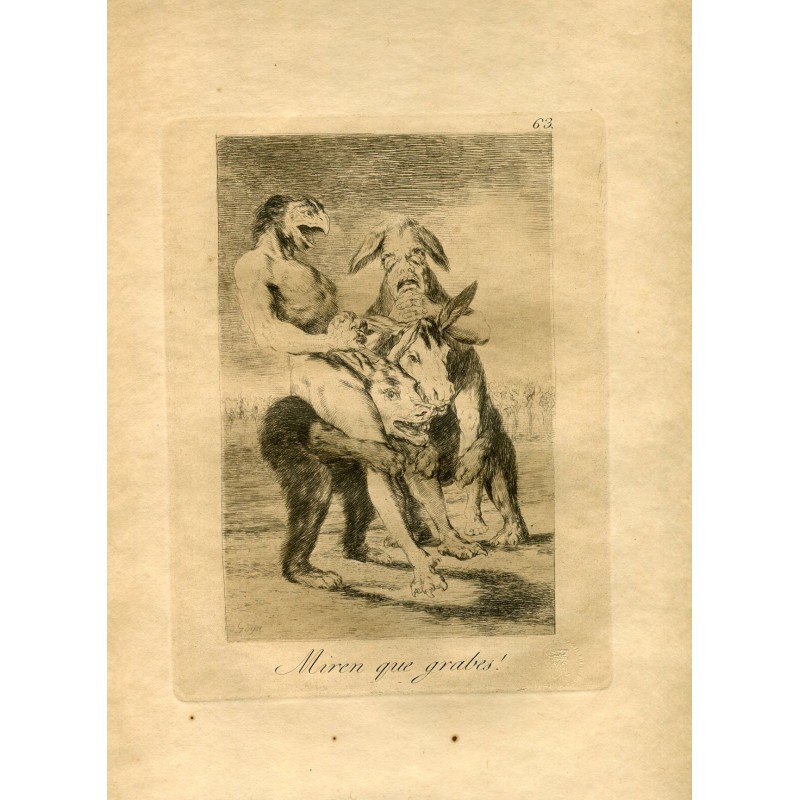
¡Miren qué grabes!, Caprichos No. 63 - Original Goya Etching - 1937 Ed.
search
  • ¡Miren qué grabes!, Caprichos No. 63 - Original Goya Etching - 1937 Ed.

¡Miren qué grabes!, Caprichos No. 63 - Original Goya Etching - 1937 Ed.

€650.00
Tax included
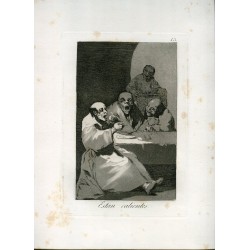
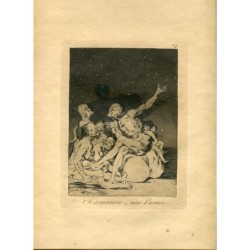
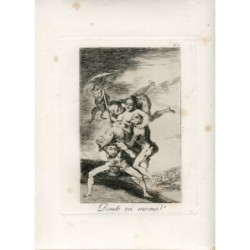
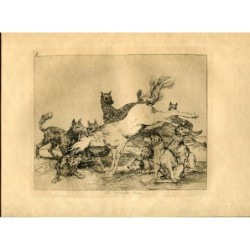
This edition was made by Rupérez in the Calcografía Nacional for the Ministerio de Instrucción Pública in 1937, during the Spanish Civil War. Plate measures: 21,4x15,1 cms. Sheet measures: 38x28,5 cms. The present engraving has the number 19 on the back. The engraving has a embossed stamp with the initials 'CN' surrounded by a border which reads: Calcografia Nacional Ministerio de Instrucción Pública. Five sets, numbered 1-5 were dedicated to Stalin, Mrs. Eleanor Rooselvet, and for the Republican President Azaña, President of the Republic, leaving two sets unaccounted for. Fifteen series numbered 6-20, on Imperial Japan paper were also issued. It appears that shortly after the outbreak of the Spanish Civil War, all Goya´s copperplates were going to be sent to Paris with a view to printing an edition there. The work was finally undertaken in the Calcografía. One of the first series issued in 1937 was gifted by the Spanish Embassy in London to the Victorian and Albert Museum, where it was exhibited. Thomas Harris states that this edition is a very well printed. Condition: In good condition. It has litttle rust spots that do not affect the image as can be seen in the pictures. 'Miren que grabes!' (Plate 63 from Los Caprichos). This stamp corresponds to the thematic group of the "power of ignorance". Goya addresses this issue through the representation of two personifications of stupidity, with expressions of enormous placidity, which are mounted on figures with the head of donkeys, a symbol of the ignorance of the people who must endure the fantasies of these two monstrous characters. Contemporary commentaries allude to the atmosphere of the court and the abuses of authority promoted by those who compose it. Los Caprichos are above all a satire conceived as a means to combat the vices of men and the absurdities of human behavior. Simplifying the series, we can group the prints around four major themes, all of them undoubtedly critical in tone. In the first of them, he addresses deception in relationships between man and woman: courtship as a common practice according to which modern man, busy with his various businesses, allowed his wife to be accompanied on his outings by a leading man; prostitution that denigrated and exploited the condition of both sexes; and unequal marriages or marriages of convenience, a common practice of his time and criticized by the enlightened. The satire of bad education and ignorance, the result of enlightened concern about this issue, is reflected in the Caprices that show the consequences of wrong teachings in children; false beliefs and superstitions produced by ignorance; and witchcraft as the supreme manifestation of lack of education and superstition. The condemnation of the vices rooted in society, and particularly in the clergy, also have a place: vanity, gluttony, laziness, lust or greed are shown to us in a caustic way in another group of prints. Finally, other Caprichos reveal their protest against the abuses of power: the Inquisition, the arrogance of the ruling classes, the exploitation of the people and the injustices of the law.
Quantity
In Stock

"¡Miren qué grabes!" is plate no. 63 of Los Caprichos by Francisco de Goya (1746-1828), signed "Goya" in the plate: two monstrous beings, one bird-headed and the other with donkey's ears and clasped hands, ride on two fantastic beasts. The series of 80 plates, published in 1799, is Goya's great satire on the vices, abuses and superstitions of the Spanish society of his day.

This impression belongs to the edition printed by Rupérez at the Calcografía Nacional in 1937, in the midst of the Spanish Civil War, for the Ministry of Public Instruction. Five numbered sets, 1 to 5, were dedicated to Stalin, Eleanor Roosevelt and Manuel Azaña, President of the Republic, two of them remaining unassigned; a further fifteen sets numbered 6 to 20 were issued on Japanese Imperial paper. This print bears the number 19 on the back. One of the first sets printed in 1937 was presented by the Spanish ambassador in London to the Victoria and Albert Museum, where it was exhibited. The sheet bears the blind stamp of the Calcografía Nacional, the letters CN surrounded by the legend "Calcografía Nacional Ministerio de Instrucción Pública". Thomas Harris notes that it is a very well engraved edition.

Medium: Etching and aquatint on Japanese Imperial paper.
Artist / after: Francisco de Goya y Lucientes (1746-1828).
Engraver: Francisco de Goya.
Date: Plates etched c. 1797-1799; printed in 1937.
Source: Calcografía Nacional, Madrid. 1937 edition for the Ministry of Public Instruction, set no. 19, with blind stamp.
Dimensions: Plate 8.4 x 5.9 in (21.4 x 15.1 cm); sheet 15 x 11.2 in (38 x 28.5 cm).
Condition: Paper toned, with a few foxing spots in the lower margin; well-marked plate mark.
10033