Si amanece, nos vamos, Capricho No. 71 - Goya Original Etching - 1970 Ed.
search
  • Si amanece, nos vamos, Capricho No. 71 - Goya Original Etching - 1970 Ed.
  • Si amanece, nos vamos, Capricho No. 71 - Goya Original Etching - 1970 Ed.

Si amanece, nos vamos, Capricho No. 71 - Goya Original Etching - 1970 Ed.

€600.00
Tax included
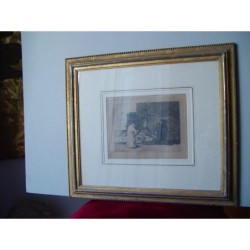
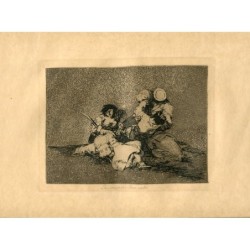
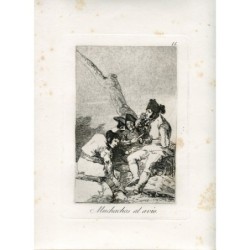
Francisco de Goya y Lucientes. 'When day breaks we will be off'. Plate 71 from Los Caprichos etching series, 1970 edition. The wove paper is watermarked with the stamp from the Calcografia Nacional. Plate size: 14,8 x 22 cm. Paper size: 26,3 x 38 cm. Los caprichos (The Caprices) is a set of 80 prints in aquatint and etching created by the Spanish artist Francisco Goya in 1797-1798, and published as an album in 1799 (first edition). The prints were an artistic experiment: a medium for Goya's condemnation of the universal follies and foolishness in the Spanish society in which he lived. Thirteen official editions are known: that of 1799, five in the 19th century, and seven in the 20th century. Being the last one in 1970 carried out by the Royal Academy of Fine Arts of San Fernando.
Quantity
In Stock

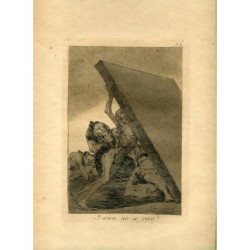
Original etching by Francisco de Goya, plate No. 71 of Los Caprichos, titled in the plate "Si amanece; nos Vamos" (When day breaks we will be off). Under a starry sky, a circle of witches and deformed beings gathers around a figure who, seated on a large bundle, points upwards with an outstretched arm; in the background, other figures carry children. It is the night-time coven that must break up before dawn.

It belongs to the 1970 edition of the Calcografía Nacional, printed from Goya's original plates. The paper bears the watermark with the Calcografía Nacional seal and the date 1970.

Medium: Etching and aquatint.
Artist / after: Francisco de Goya y Lucientes (1746-1828).
Engraver: Francisco de Goya y Lucientes (1746-1828).
Date: 1970 edition.
Source: Calcografía Nacional, Madrid.
Dimensions: Plate 5.8 x 8.7 in (14.8 x 22 cm); sheet 10.4 x 15.0 in (26.3 x 38 cm).
Condition: Very good condition; clean, heavy laid paper with wide margins and a well-marked plate mark; number "71" at the upper right corner of the plate.
1882